


|
What Causes Heat Waves, And Why Are They Dangerous?
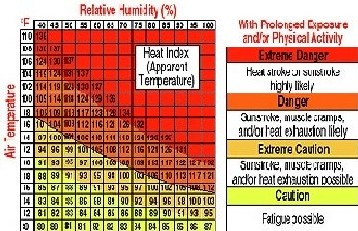
Heat waves are a poorly recognised form of severe weather, but rate second in weather related causes of death. But just what are heat waves? A heat wave is somewhat loosely defined as a period of abnormallyand uncomfortably hot, and usually humid weather. That's OK so far, but let's look into it a bit further. The other significant words in the definition are "abnormally"and "uncomfortably". What may be abnormal and uncomfortable heatto a resident of Wisconsin may not be anything out of the ordinary to someone living in Houston. Similarly a run of hothumid days in late spring or early summer may feel much more unpleasant than the same conditions in late summer, when people are more accustomed to higher temperatures. Although significant, these regional or seasonal differences do not concern the forecasters and public health people. There is always a proportion of the population who are at risk during heat wave conditions, and will benefit from warnings and the provision of emergency facilities. The Heat IndexI'm sure everyone has noticed that some days feel hotter than others, even though the recorded temperature may be the same, or even lower. This is not just imagination - it's a very realphenomenon that corresponds to how well our body is coping with the heat. Our core temperature is normally 98.6F, or 37C. Our systemsstruggle when our temperature rises to 102F (39C), and we areat risk if temperatures are sustained at or higher than 104F(40C). So if the air temperature is higher, we need some means to cool us down. Our systems have a number of ways of doing this, but the mosteffective is through evaporation of perspiration. Blood isdirected close to the skin, perspiration is produced, and asit evaporates it cools the skin and the nearby blood, which in turn keeps our body temperature at safe levels. On hot days with low humidity, perspiration evaporates quicklyand we stay reasonably comfortable - even more so if thereis reasonable air movement. But on days of high relative humidity, the capacity of the air toabsorb more moisture is low. Perspiration evaporates slowly, and not only do we feel sticky and clammy, but we are not cooling downas fast as we'd like. Consequently we sense the temperature as being higher than it is. The difference between the apparent temperature, which we feel,and the measured temperature can be calculated using a formulato produce the Heat Index. It is shown in chart form below, and any combination of actual temperature and relativehumidity can be converted to an apparent temperature, giving a better guide to what we feel, and the effect the conditions are having on us.
This chart, developed by NOAA, shows temperature in Fahrenheit - as a rough guide, 82F= 28C, 100F = 38C, and 110F is a shade over 43C.
The National Weather Service issues heat advisories for days when the heat index is expected to reach values between 100 and 114F (38-46C). These are days when the heat and humidity is expected to be an inconvenience for most of us, and a problem for some.
Excessive Heat warnings are issued when the Heat is expected to exceed 115F, when conditions become dangerous for a large proportion of the population.
Recently, it has been recognised that health problems and fatalities are not just related to maximum heat index values during the day, but are strongly linked to high minimum temperatures at night. The effects of heat build with time, and the stresses of hot days can be partly overcome by rest in the cool of the night.
But on very humid days, the water vapour in the atmosphere limits the effect of radiation of heat into the atmosphere, and night time temperatures, particularly apparent temperatures, stay high. People under heat stress during the day have little opportunity to recover overnight.
Heat advisories and warnings now take this into account.
How Dangerous are Heat Waves?
Heat waves are among the most lethal of weather conditions, although it took authorities a long time to recognise this.
Direct health problems come from dehydration, particularly affecting babies who lose fluid at a higher rate than older children and adults, and heat stroke, when a person's body reaches 105F, perspiration stops, and they ultimately lose consciousness.
Heat stroke can happen during exertion outdoors - an unexpected trap for runners, joggers and cyclists trying to maintain a fitness program during a heatwave- or by being confined in a poorly ventilated room.
But heat waves lead to far more deaths from the stress imposed on the elderly and ill. The difficulties in coping with the heat and humidity are often enough to aggravate other health problems, particularly involving the heart and lungs, resulting in deaths which otherwise may not have occurred until well into the future.
These indirect fatalities show up in comparisons between deaths during and immediately following the heat wave with those occurring in other years when conditions were normal.
Heat waves are therefore responsible for more deaths, on average, than any other weather related phenomenon except extreme cold. Here are some recent figures for the USA
The 1995 figures include the Chicago heat wave of July that year, which acted as a wake up call to both the severity of heat wave effects on health, and the inadequacies of warnings and responses from emergency and health services.
Even worse was the European heat wave of August 2003, where, depending on how the comparisons are made, between 11,000 and 15,000 people died as a result of prolonged hot humid conditions.
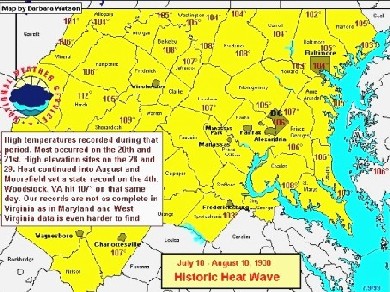
July/Sugust 1930. Source NOAA
Causes of Heatwaves
Heat waves result from similar causes to droughts and some types of fire weather although as a general rule heat waves are accompanied by higher humidity.
They are usually associated with ridges or zones of high pressure, including upper level highs. These highs lead to warmer air because of pressure effects, but are also associated with clear skies, more sunlight, and higher temperatures as the land and air heat up. If the high is stationery or blocked, a succession of hot days results, often with temperatures increasing on each succeeding day.
Upper level highs may also put a cap on the underlying hot air, preventing convection and mixing with cooler air at altitude. Clockwise circulation around the high may also bring in humid air from elsewhere - a common feature of eastern US heatwaves is a high over the south east bringing in humid gulf air to its west.
But usually there are other factors involved in the severe heatwaves, which normally would not have great effects on their own. But add them to the mix, and problems can arise.
As an example, the 1995 Chicago heat wave coincided with a fairly light airflow from west to east. This carried in humid air, partly resulting from evaporation from extensive croplands to the west. But it also stopped the lake breezes which help cool the city on most hot days. The result was still, hot humid days and human tragedy which was unexpected.
A final factor in the Chicago heat wave was simply that most buildings in the city are designed for the long winters with sub zero temperatures. Buildings designed to keep heat in simply do not work well on hot days.
Other types of heatwaves, generally with hot dry heat, include those associated with winds descending from mountainous areas. Winds such as the Chinook and Santa Ana move downslope, and heat up as the air pressure increases. The combination of high wind speed and high temperatures can create heat wave conditions, but humidity is usually low. Fire becomes a strong concern under these conditions, and more information is included in the page on Fire Weather. And finally, let us consider the hottest place in the USA, Death Valley. High temperatures can't really be described as heat wave conditions, because they are usual and expected. But Death Valley is affected by several of the main causes of heat waves - the frequent presence of a high pressure system (helped by its below sea level elevation), downslope air movement from surrounding mountains, and radiation of heat from the surrounding cliffs. The last feature has its counterpart in some of the more northern cities in both North America and Europe. Older stone, brick and concrete structures make their own contribution to the street temperatures simply by reflecting heat during the day, and retaining it at night.
Heat Waves and Home Weather Stations
Well, there's really not much to be said here - the temperature and humidity records tell most of the story.
However there is something to be gained from wind direction and the pressure charts. Where is the wind coming from, and is it bringing in humid air, or helping to cool things down.
Surface pressure charts will give some clues, and most weather services have them hidden away somewhere in their sites. But it is often worth checking the charts based on the 750mb and 500mb levels. The real culprit behind the heatwave may be hiding up there.
Like To Know More?
As might be expected, NOAA has a useful resource page covering Heat Waves , so slip over there if you would like to know more.
Related types of hazardous weather are included in the Hot Weather pages.
More information on Weather Stations can be found on the
Home Weather Stations
page, and there is also a
page to help you
set your weather station up.
Back to the Top, or return to the Home page. You may be interested to know that you can find out more about weather and home weather stations by receiving our newsletter ,"Watching Weather". It's published more or less weekly, and apart from tips on how to use your weather station and understand what it's telling you about the weather around you, it also covers many other weather related topics. If this sounds interesting, just add your name and email address to the form below. When you join, you'll also receive, totally free, a 20 page guide to setting up and trouble shooting problems in home weather stations. And I promise that you won't get spammed, and that your sign up details will remain totally confidential. Sign up now and receive your first issue almost immediately.
Last update 05/24/2011
|
 Blink
Blink Del.icio.us
 Digg
Digg Furl
Furl Google
 Simpy
Simpy Spurl
Spurl Technorati
 Y! MyWeb