


|
Tornadoes - Nature's Most Destructive Winds. Facts and Causes
Tornadoes are a fact of life in North America, but a little understanding goes a long way towards reducing the risks. The theme has been to get a little closer to the weather - take notes, take photos, make videos, and generally upgrade the experience of being able to record the physical aspects of the weather so easily and effectively.
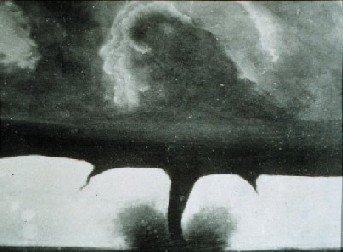
The Oldest Known Tornado Photo
But there comes a point where you should step back, move aside, or even head rapidly in the opposite direction to the approaching weather, and that, most definitely, is the case with tornadoes.
There's no doubt it would be a huge buzz to see a tornado at close hand, but its not the best sort of exploit for the inexperienced. But there are ways of reducing the risks which you can follow up in the second half of this article, Watching Tornadoes.
Some Facts About Tornadoes
Meteorologists now know quite a lot about tornadoes and how they form. But there is still a lot to learn.
As far as tornadoes go, the net is full of reports, fact sheets, photos, videos and DVDs, and some of the best of them are listed elsewhere - see More Tornado Resources . One of the most useful sources of information is an article on frequently asked questions about Tornadoes, written by Roger Edwards of the Storm Prediction Centre. Not only does it answer just about every question you may think of, but it contains numerous links to reports, research, myths and forecasting.
Tornadoes are typically a North American phenomenon, with most occurring in the USA, notably in Tornado Alley, a roughly triangular area bounded by Louisiana and Texas in the south, North Dakota in the north, and extending east to Ohio. Tornadoes are always associated with thunderstorms, and as a general rule, but not an infallible one, the bigger and more complex the storm system, the more destructive the tornado.
The larger thunderstorm systems are associated with the interface between warm humid air moving north from the Gulf of Mexico and adjacent seas, and cooler air moving southward. The interplay of these air masses has a lot to do with the type and strength of thunderstorms, and the direction they move in. Other storms and their tornado spin offs form when western dry air interacts with moist air from the Gulf
Tornadoes usually begin to form in the southern states in late winter, typically late February to March. The peak tornado season gradually moves north during spring. May and early June are the most active months in the southern plains, while in the northern plains and upper midwest the peak is in June or July. But if the conditions are right, tornadoes will develop at any time and almost any place.
Overall the peak season on an all state basis is in May/June, with both months experiencing, on average, over 180 tornadoes. Here are a few tornado facts
So how can you gain experience in severe weather observation without putting yourself at risk of injury or death? Follow this link to the Watching Tornadoes.
Supporting resources on tornadoes, including the best of available books, DVDs and posters, can be found at More Tornado Resources, while these pages will give you more information on Waterspouts (and other fast rotating winds), Thunderstorms and other types of Severe Weather.
You may be interested to know that you can find out more about weather and home weather stations by receiving our newsletter ,"Watching Weather". It's published more or less weekly, and apart from tips on how to use your weather station and understand what it's telling you about the weather around you, it also covers many other weather related topics. If this sounds interesting, just add your name and email address to the form below. When you join, you'll also receive, totally free, a 20 page guide to setting up and trouble shooting problems in home weather stations. And I promise that you won't get spammed, and that your sign up details will remain totally confidential. Sign up now and receive your first issue almost immediately. Last update 05/28/2011
|
 Blink
Blink Del.icio.us
 Digg
Digg Furl
Furl Google
 Simpy
Simpy Spurl
Spurl Technorati
 Y! MyWeb